
People often ask me which Chitrakaari collection is my favourite. I usually say I don’t have one. But if I am honest, Around the World is the one I think about most. It started with a simple question: how can a wall make you feel like you are somewhere else?
Where the idea started?
I have travelled places and everytime I look around, I cherish how each place has its own uniqueness. After that, I kept noticing how many people keep small pieces of travel in their homes. A fridge magnet from Jaipur. A postcard from Paris. A globe on a child’s study table. These things are small, but they mean a lot to people. I wanted to take that feeling and give it a whole wall.
What is in the collection?
Around the World has three kinds of designs.
- Maps. Hand-drawn world maps with continents, oceans and small details you only notice when you stand close. A map is useful as well as beautiful. Children point at it and ask questions. Adults find the places they have visited.
- Cities and monuments. Skylines and famous landmarks, drawn as one connected scene. In our catalogue we call this idea “Monuments Mapped,” because we wanted landmarks from different countries to sit together on one wall.
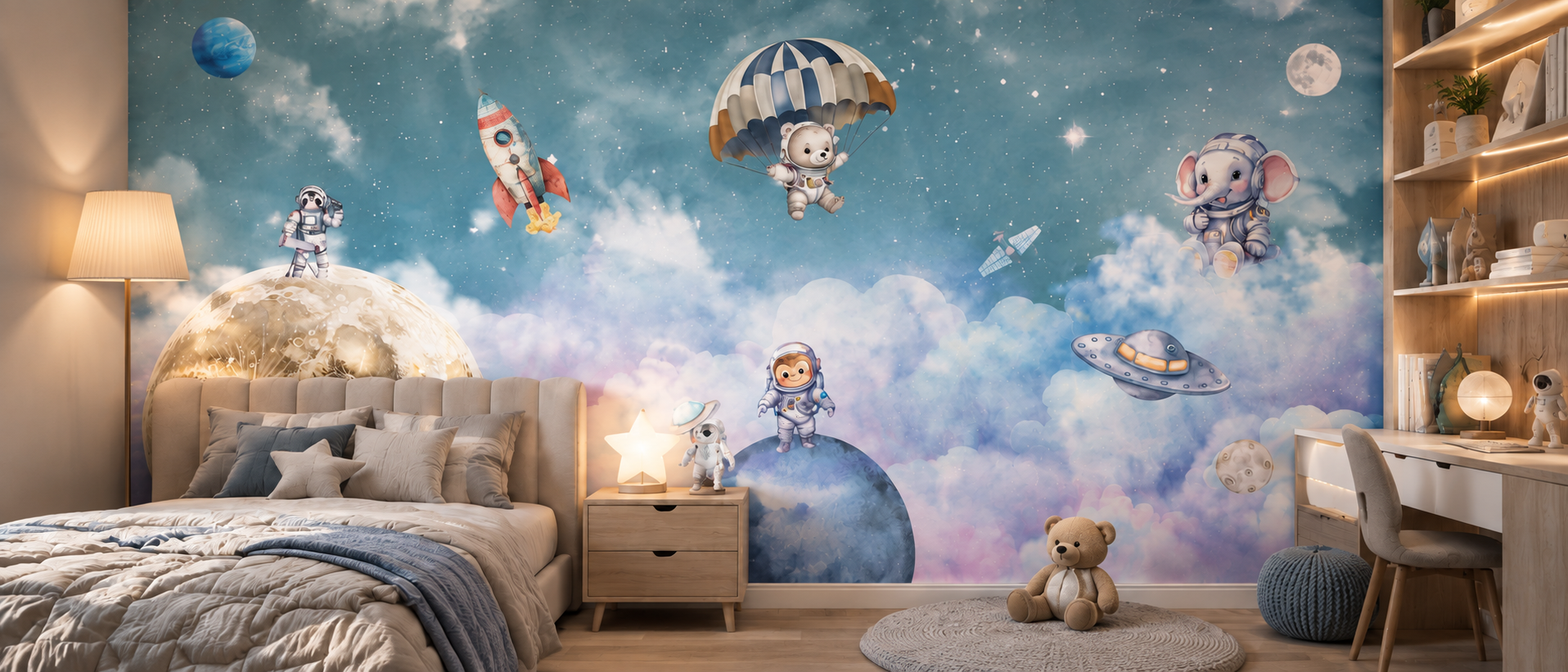
- Space. Planets, stars, galaxies and astronauts. We added these because travel does not have to stop at the edge of the Earth. Many children want to be astronauts before they want to be anything else.
How a design goes from idea to wall
Every Chitrakaari design goes through the same steps.
- Research. We collect references: old maps, photographs of cities, pictures from space. We study shapes and colours, but we do not copy. Every design is drawn by our own team.
- Sketching. The first drawings are rough. We decide what goes where. On a map, this means choosing which details to show and which to leave out, so the wall does not look crowded.
- Colour. This step takes the longest. A world map can look like a school chart or like a piece of art, and the colour decides which one it becomes. We test soft, muted colours for living rooms and brighter ones for kids’ rooms.
- Scale check. A design that looks good on a screen can look very different on a 10-foot wall. We print test sections and check them at full size before we finalise anything.
- Printing. Every order is custom made to the size of the customer’s wall, so the design fits the space correctly and does not look cut off at the edges.
Who this collection is for?
When we started, I thought Around the World would be mainly for kids’ rooms. It works very well there. A child who falls asleep looking at the planets, or who learns where Brazil is from their bedroom wall, gets something extra from the design.
But our customers showed us more uses. We have seen these designs in:
- Study rooms, where a world map helps people stay curious while they work
- Home offices, where a city skyline looks professional and modern
- Living rooms, where one feature wall becomes the first thing guests talk about
- Cafés and co-working spaces that want a travel feel without a lot of décor
How to style it in your home?
- Choose one wall. These designs are detailed, so one feature wall is usually enough. Keep the other walls plain.
- Match the colour to the room. Pick muted colours for bedrooms and living rooms. Pick brighter colours for kids’ rooms and play areas.
- Add small travel pieces. A globe, a vintage suitcase or framed postcards on a shelf near the wall help the theme feel complete.
- Think about light. A space design in a kids’ room looks especially good with warm, soft lighting at night.
What this collection means to me?
Chitrakaari has always been about one idea: imagination is the beginning of creation. Around the World is the clearest example of that. You don’t need a plane ticket to feel curious about the world. Sometimes you just need the right wall.
If you want to bring a little of the world into your home, our team would be happy to help you choose the right design and size for your space.